AI is not taking our jobs. It’s changing them.
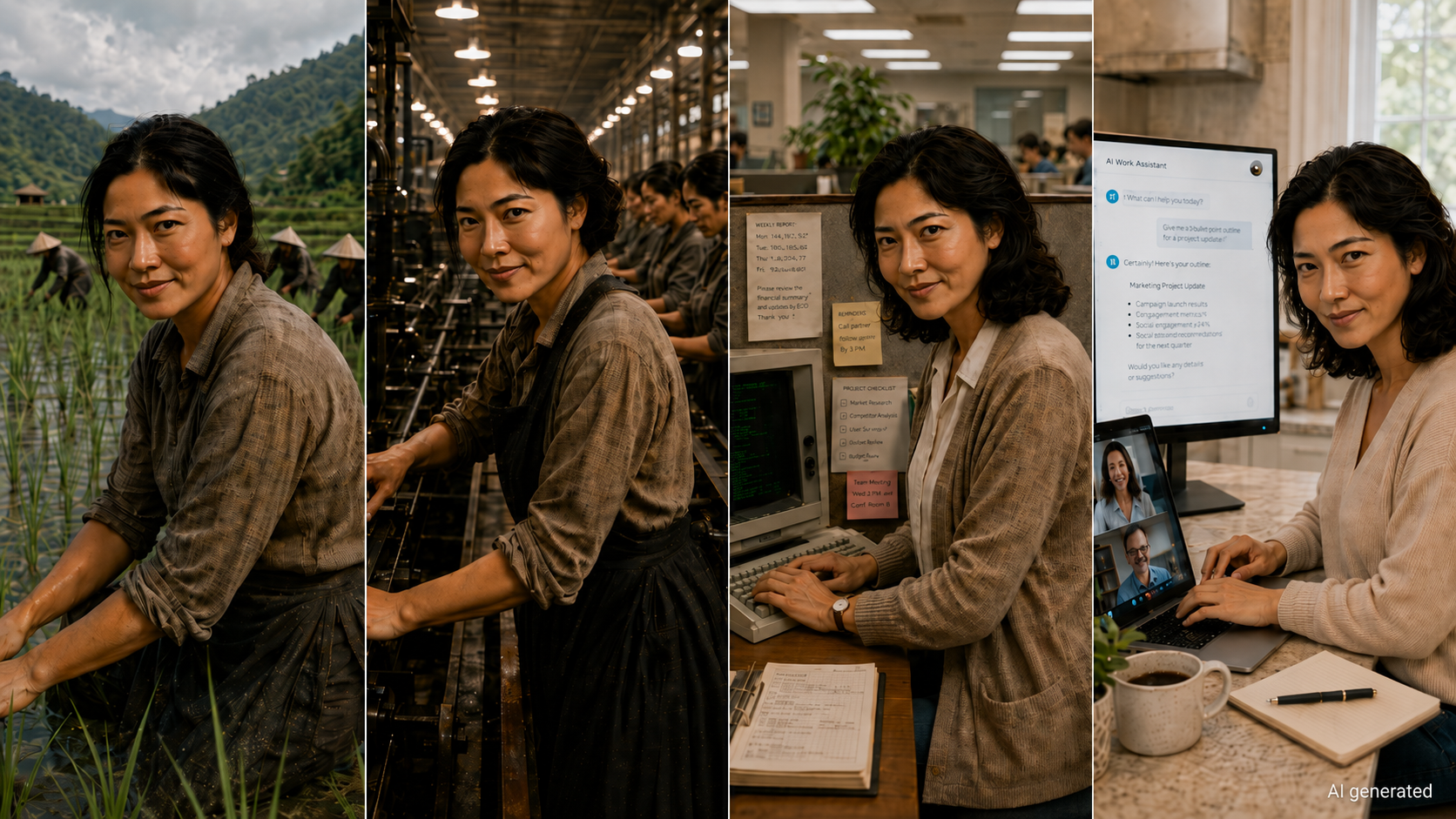
Every week, AI creates new opportunities for innovation and productivity. And every week, it raises a hard question: what about human work?
“AI is taking our jobs” is a common fear. The Brookings Institution estimates 6.1 million US workers, about 4% of the workforce, face the highest risk of permanent displacement. These workers are those with the least room to adapt, lacking the education, skills, or networks to pivot. These are real people facing real disruption.
But “taking our jobs” is the wrong perspective. In fact, the AI revolution is just the latest transformation in the nature of human work that started over 200 years ago.
From farms to factories to cubicles to the kitchen table
For thousands of years, the vast majority of people worked the land: farming, livestock, fishing, forestry. In the 1800s, the Industrial Revolution moved work from outdoor farms to indoor factories. Jobs involved manufacturing automobiles, food, clothing, electronics, and other goods. By the late 1980s, another tectonic shift occurred as computers accelerated growth of the service economy.
Over two centuries, jobs moved from farms to factories to cubicles. And for many, work recently shifted from office buildings to the home. My point is this: the nature of work has been evolving for 200 years. What we think of as a typical job today did not exist just a few decades ago.
AI is simply the latest driver of the next stage in human work. As Solomon wrote, “there is nothing new under the sun” (Ecclesiastes 1:9). Work has changed before, and is changing again. God is not surprised by any of it.
I recognize that the AI transformation feels faster and broader than the ones that came before. But if you push past the headlines, you’ll start to see that humans are already adapting to an AI-enabled workplace.
Radiologists were supposed to disappear
In 2014, Eyal Gura (a Wharton classmate) cofounded Zebra Medical Vision, a startup using AI-driven imaging technology to improve diagnosis of X-rays, mammograms, and CT scans. Zebra became a pioneer in the space, developing the first at-scale AI deployment in medical imaging. Shortly afterwards, Geoffrey Hinton—a Nobel laureate and often called the godfather of AI—declared, “People should stop training radiologists now.” Within five years, he was certain, there would be little need for human radiologists.
He was wrong. Today in the United States there is more demand than ever for radiologists. AI did make reading scans faster and more accurate, but that was only part of the job. Radiologists also advise surgeons, sit with patients, and bring experienced discernment to findings. As reading images became cheaper, more images were ordered. Cheaper reads created more reads, not fewer readers.
The radiologist’s job changed. It did not disappear.
Erik Brynjolfsson of Stanford Digital Economy Lab says the real question is not human versus machine but human with machine. His research reveals that AI does not generally replace human skill. It can accelerate it.
AI rarely replaces a human’s job in its entirety. Most jobs are bundles of tasks, and AI handles some of them well. But the discernment, relationships, and calling that bind those tasks into a job are far harder to replace.
AI is not taking our jobs. It’s changing them.
So what should a leader do? Not wait. You cannot lead your organization through the AI revolution by reading about it. You learn by using it.
Whatever your context, whether you lead a church, ministry, or business, AI tools can help you operate more efficiently and advance the work God has given you. And if you are not intentionally shaping how your organization uses AI, the tool is shaping your organization by default. That is not stewardship. That is abdication.
As Christ-followers, we can say with confidence that technology does not get the final word on human flourishing. God does. And under His sovereignty, leaders still have real responsibility for how these tools are adopted, governed, and used.
God placed the first human in the garden to work it and keep it (Genesis 2:15). Work came before sin, before wages, before the idea of a job. Its dignity was never anchored in what we produce, but in who we are: image-bearers of the God who made us. “Being a Christian leads us to see our work not as merely a way to earn money nor as primarily a means of personal advancement,” says Tim Keller, “but truly a calling—to serve God and love our neighbor.”
AI can automate tasks, increase efficiency, and replace some of our job responsibilities. But it cannot change our image or our calling.
The nature of human work has changed before. It will change again. How it changes is ours to steward.
Questions for you and your team:
Is there fear in our organization about the impact of AI on jobs? If so, how do we address that with truth and grace?
How can we intentionally encourage the appropriate adoption of AI tools to absorb routine work and increase efficiency?
As AI absorbs more of the routine, what uniquely human work should our people be doing more of, and are we building toward it?
Download the first chapter of Future-Perfect for free at: srobertyi.com/fpi
